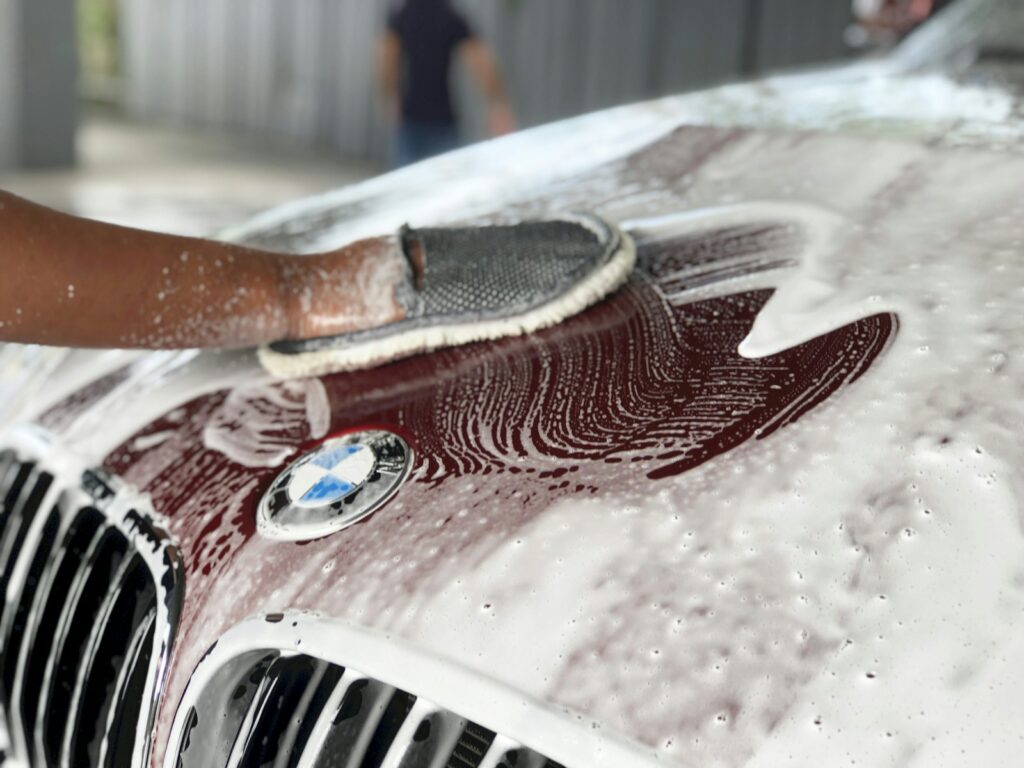
Illustrative photo: washing a car by hand. Clarence Tioh / Unsplash.
Mud, road salt and snow can hide the characters on a number plate. Plates must be easy to read in traffic, so cleaning them is part of routine car care. Start with a mild cleaner and check the result. If the surface is damaged, stronger cleaning will not restore it.
Start with water and a mild cleaner
Traficom lists ordinary household cleaners, such as washing-up liquid, as suitable products. Still check the ingredients and instructions for your chosen product: not every household cleaner is suitable for a plate’s surface. Follow the recommended dosage.
- Stop somewhere safe. Check the car’s front and rear plates before cleaning. Look for dirt, snow or visible damage.
- Rinse off loose dirt. Do not rub dry grit against the plate. Use a clean, soft cloth or sponge without abrasive particles.
- Wash gently. Clean the plate with a mild cleaning solution, then rinse the cleaner off. Check the edges too, where dirt may remain.
- Look at the plate again. Make sure every letter and number is clearly visible. Also check that the plate is not loose and that its frame does not cover it.
This washing sequence is practical editorial advice. Traficom’s guidance identifies suitable and unsuitable cleaning products; it does not specify a particular cleaning tool or brand.
Do not use windscreen washer fluid
The windscreen washer fluid already in your car is not a number plate cleaner. Traficom also advises against using petrol, paint removers or cleaning products containing active chlorine.
Other products to avoid include solvents containing chlorinated hydrocarbons and solvents containing substantial amounts of aliphatic alcohols, ketones, esters or aromatic solvents. Traficom’s examples include ethanol, acetone, toluene and thinner.
A product’s name or intended use alone does not reveal its ingredients. If its composition is unclear, do not test it on the plate. Check the product information or ask the manufacturer. Do not mix different cleaning products.
What about stubborn dirt?
Traficom’s list of suitable products also includes aromatic-free white spirit and solvents containing aliphatic hydrocarbons. This does not mean that every white spirit or engine cleaner is automatically suitable. Check the specific product’s ingredients and instructions before use.
If gentle washing does not help, pause to assess the surface. Is dirt still attached, or has a character worn away or the surface layer come off? Do not keep scrubbing harder or use abrasives. If you cannot distinguish dirt from damage, ask for advice and explain which product you have already used.
Check legibility and attachment
All the characters on a clean plate must be clearly visible, and no part of the plate may be covered. A loose attachment needs repairing even if the plate otherwise looks tidy. Check both plates even when only one looked dirty.
A replacement must be requested for a defaced plate. If damage still makes the plate difficult to read after washing, see our guide to replacing a lost or damaged number plate. Treat cleaning and repairing damage as separate jobs.
Make a habit of checking the plates when you check the car’s lights. In muddy or snowy conditions, you may also need to check them during a journey at a safe stopping place.
Sources and verification
- Traficom: number plates and cleaning products (in Finnish)
- Finland’s Vehicles Act 82/2021, sections 100–102: attachment, legibility and defaced plates (in Finnish)
Information checked on 6 November 2026. The washing sequence was compiled by the editorial team.