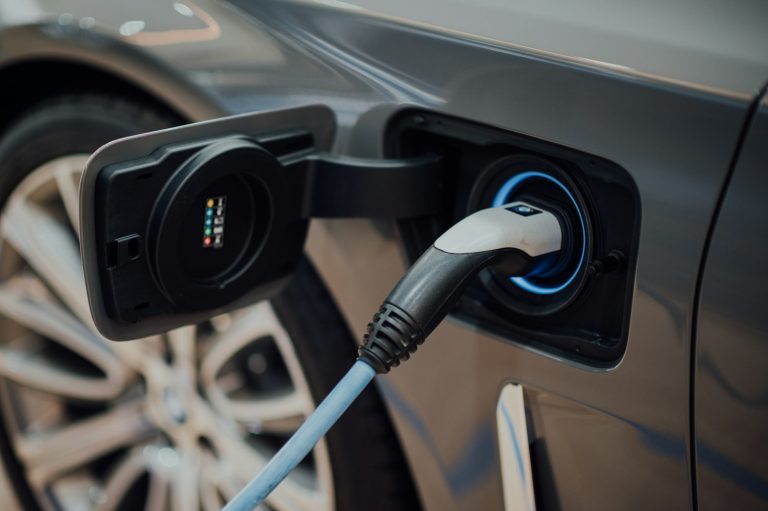
Illustrative photo: Bence Balla-Schottner / Unsplash. The image does not depict the news events.
- In October, 3,417 fully electric cars accounted for 60 per cent of new passenger-car first registrations. The total market for new passenger cars was nevertheless smaller than a year earlier.
- On 5 November, the government submitted legislation to strengthen cross-border cooperation on traffic offences in the EU. The change is not yet in force.
- A joint authority check in Helsinki on 6 November found shortcomings in 20 of 43 taxis. The result cannot be generalised to the whole industry.
- Pedestrian deaths in January–September rose from 13 to 19, emphasising visibility and speed appropriate to conditions.
Fully electric cars accounted for 60 per cent of new passenger cars in October
Statistics Finland published October’s first-registration figures on 5 November. During the month, 5,685 new passenger cars were registered for the first time, 9 per cent fewer than a year earlier. There were 3,417 fully electric cars: their share was 60 per cent and their number rose by 54 per cent year on year. Plug-in hybrids numbered 550, around 10 per cent. Rechargeable cars therefore had a combined share of 70 per cent.
The figure describes the powertrains of new cars, not the electrification of Finland’s entire vehicle fleet or used-car sales. From January to October, 62,618 new passenger cars were first registered, four per cent more than a year earlier. In October, 2,630 passenger cars, or 46 per cent, were registered for companies and organisations. Half of the fully electric cars were registered in Uusimaa.
Practical significance: anyone replacing a car should compare charging access, winter range and their own driving profile as well as the purchase price. A company should assess charging points, vehicle shifts and driver instructions before procurement. A registration share alone does not show which powertrain suits a particular task. Contact options for fleet planning are available on SK Katsastus’s business services page.
Source: Statistics Finland, 5 November 2026: first registrations in October.
Stronger EU cooperation on traffic offences is still only proposed legislation
On 5 November, the government submitted legislation to Parliament to implement new EU rules on cross-border cooperation over traffic offences. The aim is to make it easier to identify the responsible person when a vehicle is registered in a different EU country from the one where the offence occurred. Police could request technical vehicle data or personal data from another member state if register information was insufficient.
Cooperation would also cover serving documents and enforcing administrative financial penalties. If a penalty remained unpaid, help could be requested from the person’s country of residence or the vehicle’s registration country. The same bill covers a European parking card for persons with disabilities, intended to harmonise cards and their recognition across the EU.
For motorists: the proposal is before Parliament and the release gives no new date for entry into force. It does not change today’s speed limits, parking rules or penalties. Drivers abroad must continue to follow local rules, while companies should keep vehicle-holder and driver details up to date.
Source: Ministry of Transport and Communications, 5 November 2026.
Taxi checks found shortcomings in 20 vehicles – the sample should not be generalised
On Friday 6 November, police, Traficom and other authorities inspected 43 taxis in Helsinki. According to the police release published on 7 November, shortcomings were found in 20 vehicles. Ten fines were issued, along with traffic penalty fees.
A driving log was missing or incomplete in 14 cases. The driver’s name was not visible to passengers in 13 taxis, and the licence holder’s name or contact details were missing in the same number. Two vehicles were not registered for licensed use, three lacked a taxi roof light and five lacked price information. One driver had no taxi-driving licence. However, all inspected taxis had a valid transport licence, and police said most of the vehicles were in good condition and roadworthy.
A practical pre-shift checklist for an operator: visible company, driver and price information; taxi light; driving log; registration for licensed use; required licences; and tyre condition. Passengers can check the service provider and driver before the trip. The figures describe this inspection only, not quality across the entire sector.
Source: Helsinki Police Department, 7 November 2026.
In darkness, a safe speed is determined by the visible stretch of road
Police and the Finnish Road Safety Council published an autumn-darkness reminder on 5 November. Preliminary data show that 136 people died in road traffic between January and September, almost the same as a year earlier. Pedestrian deaths rose from 13 to 19, while deaths among people aged at least 75 rose from 18 to 29. The direction was not the same in every group: cyclist deaths fell from 14 to two.
Speed must allow the vehicle to stop within the visible stretch of road and in foreseeable situations. A wet road, glare, rain and a pedestrian in dark clothing reduce practical detection time. Check that lights work and windows are clean, increase the following distance, and slow before pedestrian crossings. A pedestrian reflector and working front and rear bicycle lights improve visibility.
Tyre grip affects stopping at the same time as visibility. If needed, use SK Ajossa’s interactive winter tyre check. This is a safety reminder for current conditions, not a new rule introduced this week.
Source: Finnish Road Safety Council and police, 5 November 2026.
Check the car before dark and slippery conditions
If anything about the tyres, lights, brakes or other inspection points is unclear, investigate it before the next long trip. Find a suitable location in SK Katsastus station contacts.