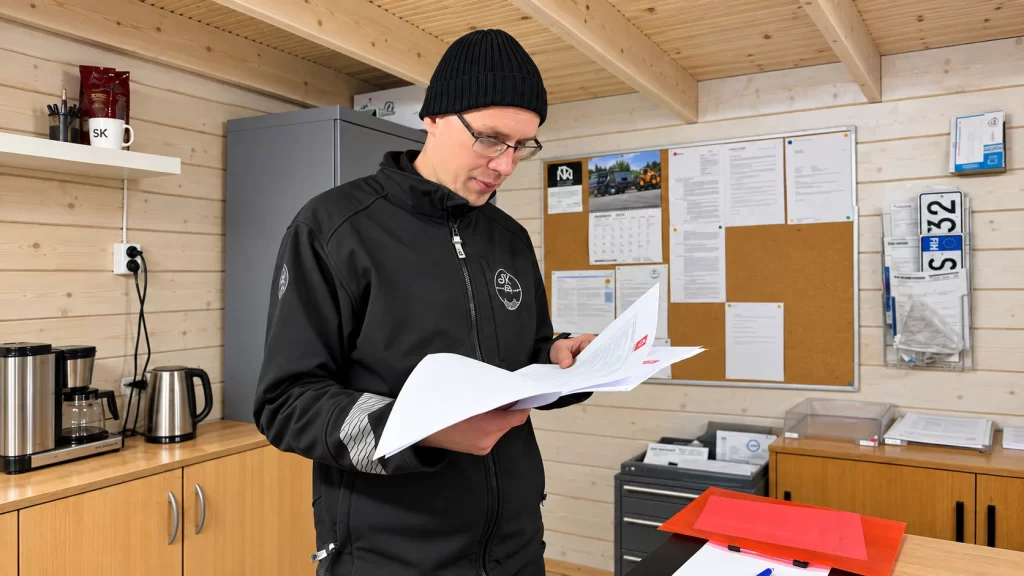
In the inspection hall, you see the brake test, headlamp checks and the vehicle being examined on a lift. A reliable inspection decision also depends on equipment maintenance, document checks, continued training and quality assurance. What does this involve in practice, and why does a visit sometimes include looking up information on a computer? This overview explains the requirements behind vehicle inspection work using official sources. It is not an interview with an individual employee or an account of a particular station’s working day.
At a glance
- A measurement is useful only when the equipment’s operation and accuracy are maintained.
- Calibration has maximum intervals, but the manufacturer’s instructions must also be followed.
- Inspection qualifications and training depend on the work: different vehicles and inspection types require different expertise.
- Findings and the decision are documented. Keep the inspection certificate for repairs and any reinspection.
1. The measuring equipment needs checking too
A brake tester, emissions analyser, headlamp alignment tester and other inspection equipment provide information used to assess the vehicle. Reliable measurements depend on the equipment as well as the car. A faulty sensor or unreliable result does not become usable simply because a number appears on a screen.
Maintenance and calibration are different activities. Maintenance keeps equipment working; calibration assesses measurement accuracy through comparison. Traficom’s regulation requires traceability and information about measurement uncertainty. Calibration may be performed by a competent party familiar with the equipment and with sufficient knowledge of measurement technology.
The manufacturer’s instructions must be followed. Unless EU legislation requires otherwise, the regulation sets maximum intervals of 24 months for equipment measuring weight, pressure, force and noise, and 12 months for gas-emissions instruments and gas-leak detectors. A maximum interval does not mean that malfunctioning equipment can remain in use until the next deadline.
2. Vehicle details and observations must be matched correctly
An inspector’s work involves more than looking at the car. Identification, first-use details, technical specifications and modifications affect what is checked and how the result is assessed. Similar-looking cars may be subject to different requirements.
For example, an emissions-check method can depend on the first-use date and emissions class. A modification or registration inspection may require more documentation than a routine periodic inspection. A manufacturer’s certificate or evidence about a modification may answer a question that cannot be resolved by looking at the vehicle. Requesting further information can therefore be a necessary part of making the correct decision.
3. The findings become a documented decision
The inspection certificate records the vehicle’s details, faults and deficiencies found, their classifications and the inspection result. It also includes information such as the next due date and necessary instructions. These records matter afterwards: they tell the customer and repair workshop what was found and what needs to happen next.
A repair notice, a failed inspection and a driving ban have different meanings. Review the decision before leaving the station. If necessary, ask which finding led to the result and what the certificate’s instructions mean for this particular car. Our guide to the next steps after a failed inspection provides further information.
4. Training days help maintain expertise
Traficom specifies the basic education, experience and further inspection training required of inspectors. Light vehicles, heavy vehicles and special inspections involve different training modules. Inspectors must also undertake periodic refresher training.
For the customer, this matters when choosing a service. The station’s equipment, facilities and available expertise must suit the vehicle and inspection type. A heavy or modified vehicle should therefore not be booked solely on the basis of the nearest address. Check the station information for services and vehicle limits before booking.
5. Quality depends on the whole process
An inspection licence requires quality assurance and a quality system that meets the applicable requirements. Quality management brings together equipment, staff, working methods and documentation. Its purpose is to ensure that decisions are based on the same rules and appropriate observations.
General regulations do not reveal a particular station’s maintenance calendar, internal checks or division of duties. Those details should not be inferred without information from the station itself. The broader principle is clear: a dependable customer visit requires more than an open workshop door and an inspector being present.
What should customers take away from this?
Good preparation also helps with the work behind the scenes. Mention modifications or an imported vehicle when booking. Check the necessary documents in advance and bring any separate measurement certificates. Avoid leaving a known special question until you arrive at the workshop door.
The inspection checklist helps you prepare for an ordinary visit. At the station, ask straight away about any finding you do not understand. With sound starting information, measurements and reasons for the decision, the inspection gives you a clear picture of the vehicle’s condition and the next steps required.
Choose the visit to suit the vehicle and the issue
Before booking, check that the station handles your vehicle category and the inspection type you need. Clarify uncertain document or modification questions in advance.
Sources and verification
- Traficom: inspection station facilities and equipment, section 6 (Finnish)
- Traficom: requirements for vehicle inspectors (Finnish)
- Act on Vehicle Inspection Activities, particularly section 7 (Finnish)
- Traficom: periodic inspection assessment criteria, sections 3 and 4 (Finnish)
Information checked on 1 October 2026. Author: Evelina Siekkinen. Publisher: SK Katsastus Oy.