A tyre can exceed the legal minimum tread depth and still be a poor choice for the journey ahead. One measurement in millimetres does not tell you everything about its condition. Especially in autumn, check tread depth, visible damage and pressures, and assess the expected driving conditions. This guide covers tyres for ordinary passenger cars and vans.
What do the 4 and 5 millimetre recommendations mean?
Traficom recommends at least 4 mm of tread in difficult summer conditions, for example to help avoid aquaplaning. In snow and slush, the recommendation is at least 5 mm. These recommendations relate to conditions. They should not be presented as equivalent to the legal minimum requirements.
Consider a long road journey on a rainy day. Do not base a tyre replacement decision solely on whether one measured point exceeds 1.6 millimetres. Also consider the driving conditions and the tyre’s overall condition. A tyre specialist can help assess the whole picture if necessary.
Measure each tyre in several places
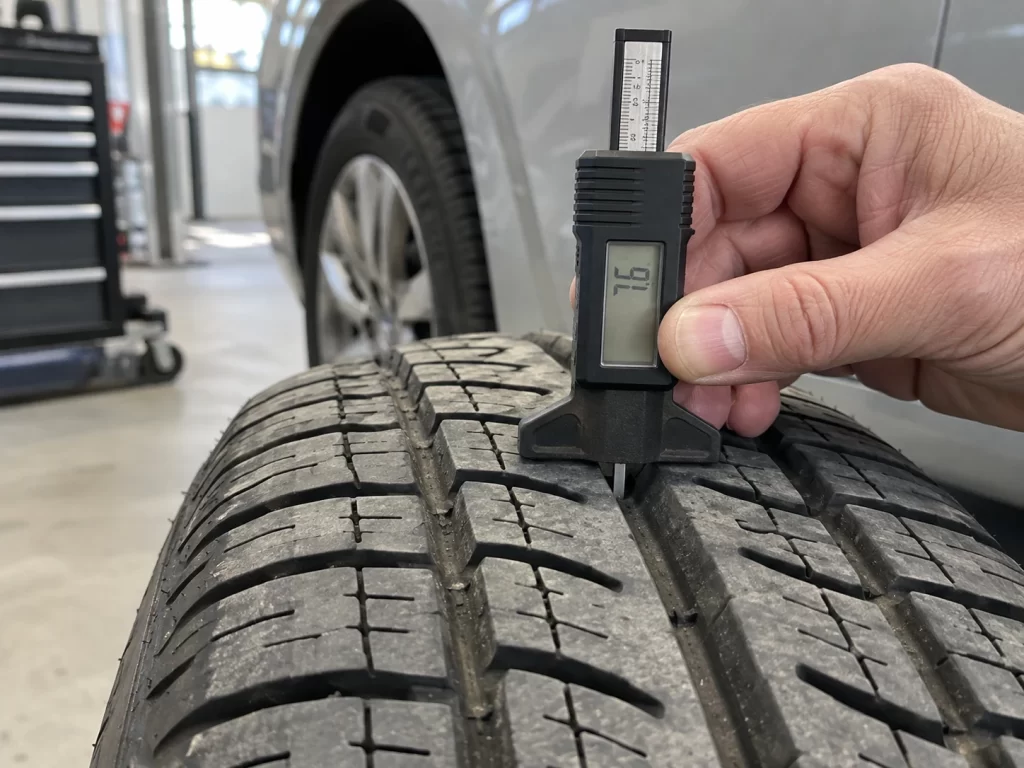
Park safely and use a tread-depth gauge according to its instructions. Check the main grooves at several points around the tyre and compare different areas of the same tyre. Measuring one easily visible spot can miss uneven wear. Do not crawl under the car or lift it just for this check unless you know the safe procedure.
Record the lowest reading and any unevenness for each tyre. This lets you show your findings to a professional and monitor the situation later. If a reading is close to the minimum, obtain a reliable check rather than round it up.
Check pressures and visible damage at the same time
Traficom recommends checking tyre pressures at least once a month. Follow your car manufacturer’s instructions and account for the load. A generic pressure figure found online may not suit your car, tyre size or load.
Also examine the sidewalls and tread: are there bulges, deep cuts or foreign objects? Good tread depth does not establish the safety of a visibly damaged tyre. If you notice anything unusual, ask a tyre professional what it means before continuing to drive. Do not remove an embedded object at the roadside just to see what happens.
Tyre type also depends on the conditions
In Finland, winter tyres must be used from 1 November to 31 March if the weather or road conditions require them. Since 1 December 2024, non-studded winter tyres for passenger cars and vans must have a snow grip marking. Check the marking before changing tyres. Other vehicle categories may be subject to different requirements.
Five checks before a tyre decision
- The main-groove depth of every tyre has been checked.
- Uneven wear has been considered.
- Visible damage has been assessed.
- Pressures follow the vehicle instructions and account for its load.
- Tyre size, type and markings suit the vehicle and its use.
The vehicle’s registration details show its approved tyre sizes. If the size has changed or suitability is unclear, ask for advice before purchasing. Find the other inspection preparation checks in SK’s checklist.
Three examples where millimetres alone are not enough
A summer tyre measures 2 mm. This is above the 1.6 millimetre minimum, but below Traficom’s 4 millimetre recommendation for difficult summer conditions. Before a long journey in rain, consider whether replacement is needed and ask a professional for an assessment. Do not turn the recommendation into a promise that a particular speed or driving style would make a worn tyre safe in all conditions.
A winter tyre has 6 mm at one point and 3 mm at another. Recording the highest reading would give an overly favourable picture of the tyre. The cause of uneven wear should be investigated. Simply moving the tyre to another position does not explain the wear or address its possible cause.
There is plenty of tread, but a bulge is visible in the sidewall. The focus now shifts to the damage. Do not decide whether a tyre is usable by calculating its average tread depth. Contact a tyre professional and describe what you have seen. If you suspect the tyre is dangerous, establish a safe course of action before setting off.
Make your visit to a tyre specialist useful
Bring the car’s details and explain how you use it. Mention, for example, towing a trailer, heavy loads and any uneven wear you have noticed. Ask for the whole set to be assessed so that buying one new tyre does not obscure problems with the others.
Note the agreed action and the findings of the check. If tyres are replaced, consult the car and wheel instructions for any steps needed afterwards. An inspection service and a tyre specialist’s work serve different purposes: share your observations at both. Clarify any inspection-related uncertainty with your station before the visit.
Traficom: Summer and winter tyres. Limits, recommendations and marking requirements checked on 6 October 2026. The practical measurement sequence was compiled by the editorial team.