An emissions check may involve a test at the exhaust pipe, a diesel smoke test or an inspection of the vehicle’s on-board diagnostics, known as OBD. The method depends on the fuel type, first-use date, vehicle category and approval details. This guide explains what is checked on petrol and diesel cars, how hybrids differ from fully electric vehicles, and what to check on a separate emissions certificate before your inspection. It describes the requirements in force in Finland on 1 October 2026.
At a glance
- An OBD check reads the vehicle’s diagnostic system. Not every car needs a probe in its exhaust pipe.
- One factor in a petrol car’s test is whether more than ten years have passed since it first entered use.
- For a Euro 6/VI diesel car first used on or after 1 September 2016, emissions are checked through OBD. Categories T and L have different rules.
- A compliant separate emissions test certificate is valid for no more than three months.
What do a petrol car’s test results tell you?
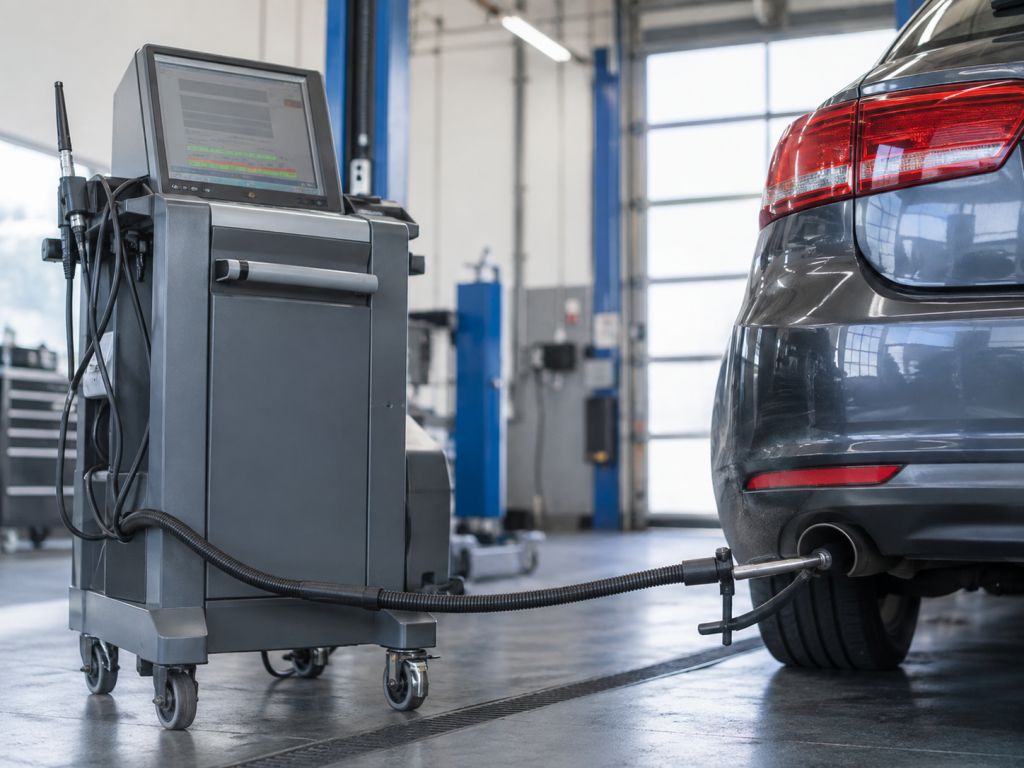
An exhaust gas analyser can measure carbon monoxide (CO), unburnt hydrocarbons (HC), oxygen (O2) and carbon dioxide (CO2). The check may also include the lambda value and engine speed. Lambda helps assess the air–fuel mixture; it is not the same as the vehicle’s stated fuel consumption.
The inspection emissions check does not establish a new fuel-consumption or CO2 rating for your car. Results are compared with the inspection limits applicable to that particular vehicle. There is therefore no single acceptable CO or HC reading that applies to every petrol car.
For an ordinary petrol passenger car no more than ten years old, the check covers the emissions warning light, OBD fault memory and system readiness. A car more than ten years old will often also have its exhaust gases measured at increased engine speed. The precise requirements depend on factors including category, mass and approval.
A practical example: an ordinary petrol passenger car first used in 2019 and a petrol passenger car with a maximum mass of no more than 2,500 kg first used in 2014 may undergo different checks in 2026. Testing the older car’s exhaust gases does not mean a fault has already been found.
For diesels, 1 September 2016 is also an important threshold
A diesel car first used before 1 September 2016 will generally undergo a smoke test. This assesses exhaust smoke using the K-value. The applicable limit depends on the vehicle’s technology and emissions level; its age alone does not identify the correct limit.
For a Euro 6/VI diesel car first used on or after 1 September 2016, emissions are checked by reading OBD fault codes. This rule does not apply to vehicles in categories T and L. For example, a Euro 6 passenger car first used in 2015 may still require a smoke test, even though its emissions class has the same name as a newer car’s. The first-use date should therefore be distinguished from the model year.
Why do the warning light and OBD readiness matter?
OBD is the vehicle’s own diagnostic system. The inspection checks the information required by the regulation, such as emissions-related fault codes and warning-light operation. For petrol cars, system readiness tests are also checked. If these have not completed, the regulation provides alternative testing methods.
Have an illuminated fault warning light investigated by a workshop before the inspection. A light going out, or fault codes being cleared, does not establish that the underlying problem has been repaired. The inspection result depends on the checks applicable to the vehicle, not simply on whether a dashboard light is visible when you arrive.
What about hybrids and fully electric cars?
A hybrid has a combustion engine as well as an electric drivetrain. Its emissions check depends on its engine, age and approval; the ability to drive on electricity alone does not by itself remove the requirement for an emissions check. Manufacturer-specific instructions are followed where necessary. You do not need to try to force a hybrid’s engine to run using your own maintenance-mode instructions before visiting the station.
A fully electric car does not undergo a combustion-engine exhaust gas test. Its other inspection items and the checks applicable to electric vehicles remain part of the periodic inspection. The absence of an exhaust emissions test does not make the inspection a mere formality.
Can you bring an emissions certificate from a workshop?
A compliant separate emissions certificate can be used at the inspection. The testing business must submit the required notification to Traficom before starting this activity. The certificate is valid for no more than three months. Using it does not replace the vehicle’s complete periodic inspection.
- Make sure the registration number and other identification details match your vehicle.
- Check the test date, testing business’s details and tester’s signature.
- Make sure all required results are included. A petrol test report and a diesel smoke-test certificate contain different information.
- Bring the complete certificate. A photograph of a single reading does not contain all the required details.
Prepare without unnecessary tricks
Keep vehicle servicing up to date and tell the inspector about known engine or emissions-system faults. A diesel smoke test requires normal engine operating temperature and appropriate preparations. The inspection station performs the test according to the manufacturer’s instructions; there is no need to carry out hard acceleration or other test procedures at home.
Also check the lights, tyres and visibility. Our inspection checklist covers the other preparations for your visit. If the vehicle fails, the reinspection guide helps you plan the next step.
What changes on 1 February 2027?
Traficom’s new regulation takes effect on 1 February 2027 and replaces the current assessment criteria. Its emissions section also covers Euro 7 vehicles. That commencement date is still ahead: inspections in October 2026 use the requirements currently in force. The change does not mean that all older cars will be required to meet the emissions class of a new vehicle.
Book the right inspection for your car
You do not need to choose the testing method yourself. The appropriate check is determined by the vehicle’s details. Choose an SK Katsastus station and book an appointment; bring any separate emissions certificate with you.
Sources and verification
- Traficom: current periodic inspection assessment criteria, sections 3.2 and 3.4 and appendix F (Finnish)
- Traficom: emissions testing and certificate requirements (Finnish)
- Traficom: regulation taking effect on 1 February 2027 (Finnish)
Information checked on 1 October 2026. Author: Evelina Siekkinen. Publisher: SK Katsastus Oy.